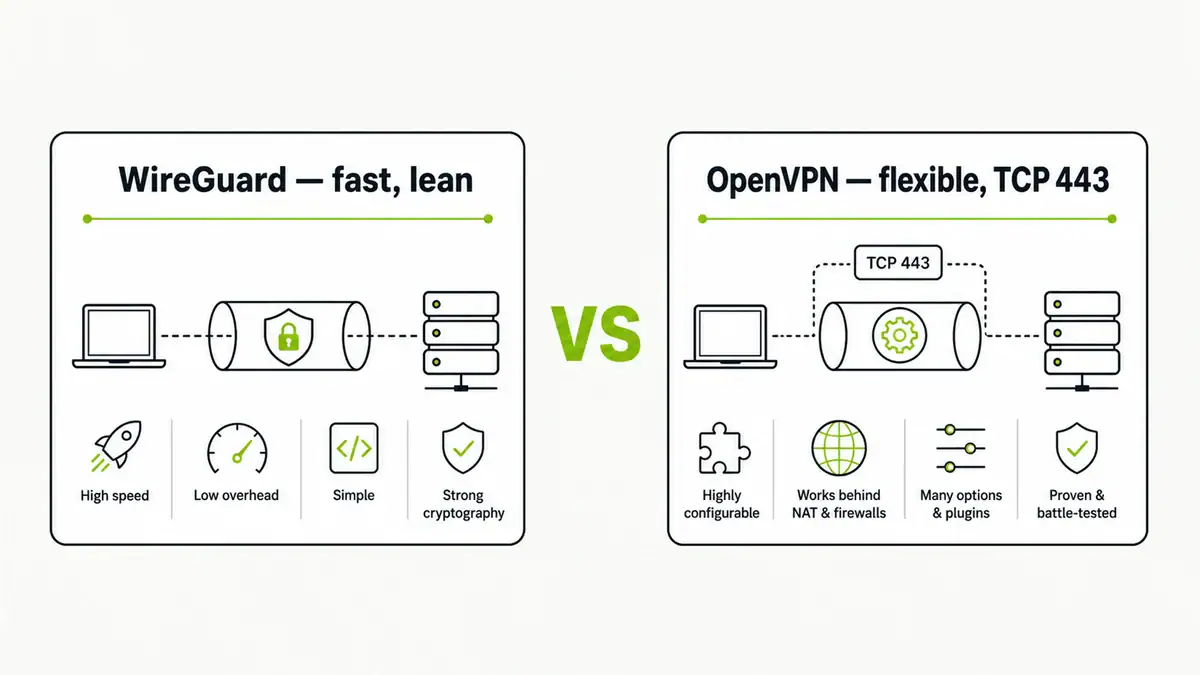
Updated June 2026. WireGuard and OpenVPN are the two protocols most self-hosted VPNs run on. WireGuard is newer, faster, and simpler; OpenVPN is older, battle-tested, and more flexible. Here is how they compare and which to pick.
Quick answer
Choose WireGuard for speed, simplicity, and modern cryptography — it is the better default for most home setups and mobile devices. Choose OpenVPN when you need maximum flexibility, TCP fallback, or traffic that blends with HTTPS to get through restrictive firewalls. If you want WireGuard’s speed without hand-configuring peers, a mesh like Tailscale runs on it. To roll your own, see WireGuard on a Raspberry Pi.
Head to head
| Factor | WireGuard | OpenVPN |
|---|---|---|
| Speed | Faster, lower overhead | Slower, heavier |
| Config | Tiny, key-based | Larger, certificate-based |
| Codebase | Small (~4k lines), easy to audit | Large, mature |
| Transport | UDP only | UDP or TCP |
| Obfuscation | None natively | Can blend with HTTPS (TCP 443) |
| Mobile | Excellent, fast reconnects | Works, heavier on battery |
| Best for | Speed and simplicity | Flexibility and firewall evasion |
When each wins
- WireGuard: home VPN servers, fast mobile access, low-power devices like a Raspberry Pi, and anyone who wants a config they can read top to bottom.
- OpenVPN: networks that block UDP, situations needing TCP 443 to look like normal web traffic, and setups already invested in OpenVPN certificates.
Security
Both are secure when configured correctly. WireGuard uses a fixed, modern cipher suite and a small codebase that is easier to audit. OpenVPN is highly configurable, which is powerful but means weak settings are possible — use current defaults. For everyday privacy, either protects your traffic well.
FAQ
Is WireGuard faster than OpenVPN?
Yes, generally. WireGuard has far less overhead and a leaner codebase, so it is faster and reconnects quicker, especially on mobile. The gap is largest on low-power hardware.
Is WireGuard or OpenVPN more secure?
Both are secure when set up properly. WireGuard uses fixed modern cryptography and a small, auditable codebase; OpenVPN is flexible and mature but can be misconfigured. Use current defaults for either.
Which is better for getting through firewalls?
OpenVPN, because it can run over TCP port 443 and blend with HTTPS traffic. WireGuard uses UDP only and is easier to block on restrictive networks.
Which should I use for a home VPN?
WireGuard for most people, thanks to speed and simplicity. Choose OpenVPN if your network blocks UDP or you need its flexibility.
Is Tailscale WireGuard or OpenVPN?
Tailscale is built on WireGuard, adding a control plane and NAT traversal so you get WireGuard’s speed without manually configuring peers.
Sources checked
Final take
For most home labs and mobile use, WireGuard is the better default: faster, simpler, and easy to audit. Reach for OpenVPN when you need TCP, obfuscation, or its flexibility. Either way, a Raspberry Pi makes a great VPN server, and Tailscale is the easiest on-ramp to WireGuard.
Get notified whenever I post something new. No spam, and it helps a lot!


Leave a Reply